
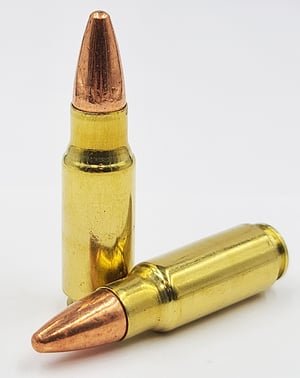

Load Specifications
Load data in caliber .375 SOCOM with .375 | 270gr | Alaska Bullet Works Kodiak PP SPBC bullet and 6 powders. The key underlying parameters are shown in the table above. The recommended powders for this cartridge and bullet combination are Alliant AR-Comp, ReloadSwiss RS 14 and Hodgdon TrailBoss.
Important Notice: DO NOT go below Minimum Charge or above Maximum Charge. Since we have no control over the equipment and components used, any responsibility and liability for the results achieved is rejected.
Only powders/loads that match the current filter criteria are displayed: max pressure of a load ≤ 90% of max. standardized pressure, fill rate ≥ 80% and propellant combustion ≥ 95%. Use the sliders above the tables to adjust these thresholds.
Charge: Powder weight in grains. Start with the minimum load and work up carefully.
FR (Fill Rate): Case fill as a percentage. Values above 100% mean compressed loads.
MaxP / %: Maximum chamber pressure in bar and as a percentage of the standardized maximum for this caliber.
V(0): Muzzle velocity in feet per second (fps) at the standardized barrel length.
z (Powder Burn): Estimated propellant combustion percentage at bullet exit.
A valid access license is required to use the Personalized Load Calculator.
You can find more information in our FAQ: How can I use the Personalized Load Calculator?
Max Load - Barrel Length: 16"
| Powder | Charge | FR | MaxP | % | V(0) | z |
|---|---|---|---|---|---|---|
| Alliant AR-Comp | <<locked>> | 92% | 31,575 psi | 90% | 1818 fps | 97.3% |
| Alliant Reloder-10x | <<locked>> | 84% | 31,183 psi | 89% | 1768 fps | 96% |
| Hodgdon TrailBossᴾ | <<locked>> | 100% | 31,270 psi | 89% | 1194 fps | 100% |
| ReloadSwiss RS 14ᴾ | <<locked>> | 100% | 31,125 psi | 89% | 1224 fps | 100% |
| ReloadSwiss RS 14ᴾ | <<locked>> | 100% | 22,902 psi | 65% | 1089 fps | 100% |
| Vihtavuori N130 | <<locked>> | 86% | 31,415 psi | 90% | 1732 fps | 95.7% |
Recommended = one of the top powders for this cartridge and bullet combination.
Start Load - Barrel Length: 16"
| Powder | Charge | FR | MaxP | % | V(0) | z |
|---|---|---|---|---|---|---|
| Alliant AR-Comp | 34.9 gr | 88% | 28,137 psi | 80% | 1745 fps | 95.7% |
| Alliant Reloder-10x | <<locked>> | 82% | 29,283 psi | 84% | 1732 fps | 95.2% |
| Hodgdon TrailBoss | 11 gr | 80% | 22,887 psi | 65% | 1063 fps | 100% |
| ReloadSwiss RS 14 | 11.3 gr | 80% | 22,902 psi | 66% | 1093 fps | 100% |
| ReloadSwiss RS 14 | 11.3 gr | 80% | 16,998 psi | 49% | 971 fps | 100% |
| Vihtavuori N130 | <<locked>> | 84% | 29,733 psi | 85% | 1699 fps | 95% |
Recommended = one of the top powders for this cartridge and bullet combination.
ᴾ possible press load - work up slowly to this load while watching for signs of excessive pressure.
This overview compares 6 powders for .375 SOCOM loaded with the .375 | 270gr | Alaska Bullet Works Kodiak PP SPBC. Alliant AR-Comp delivers the highest muzzle velocity at 1,818 fps; across all powders the maximum-charge window runs from 1,089 fps to 1,818 fps. Hodgdon TrailBoss gives the best case fill at 100 %, and 6 of the 6 powders fall inside the usable 80–100 % fill window.
Relative to the caliber's maximum pressure (241 MPa), the top charges use 65–90 %, leaving at least 10 % headroom. The 270.0 gr projectile in 0.375" calls for a 1:6.0 twist; slower twists will usually not stabilise this weight. Hodgdon TrailBoss, ReloadSwiss RS 14, ReloadSwiss RS 14 reach 100 % fill or more at maximum charge, so these are compressed loads: they need a long drop tube to seat cleanly and react sensitively to the case capacity of your own brass lot. Alliant AR-Comp, ReloadSwiss RS 14, Hodgdon TrailBoss rank at the top here: for .375 SOCOM with the .375 | 270gr | Alaska Bullet Works Kodiak PP SPBC they combine a high case fill with complete burn and sit in the upper velocity band. Hodgdon TrailBoss, ReloadSwiss RS 14, ReloadSwiss RS 14 stay subsonic at start load. Always begin at the start load and work up in small increments while checking case and primer for pressure signs.